Summary
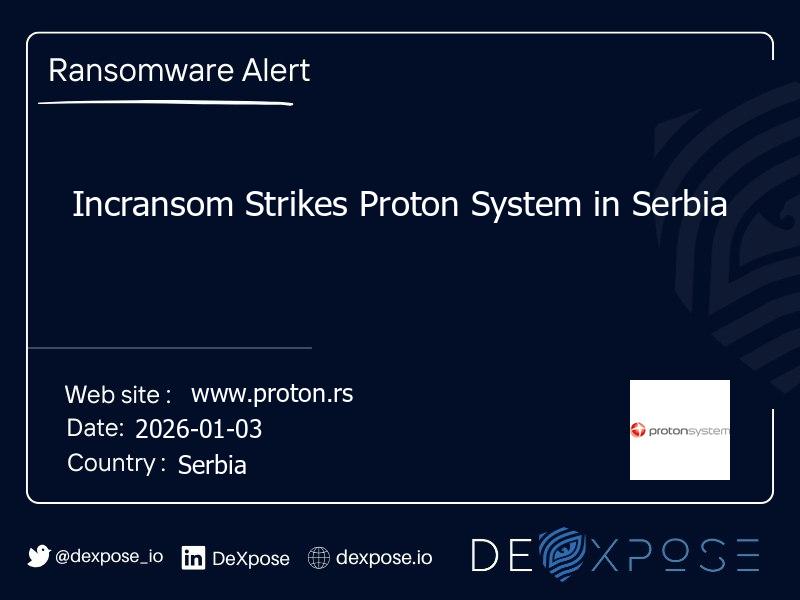
On January 3, 2026, the ransomware group Incransom publicly announced a cyberattack against
Proton System (proton.rs), a leading Serbian pharmaceutical company.
The group issued a warning that over 130 GB of sensitive data would be leaked unless the company resumed negotiations.
Incident Report
| Field | Details |
|---|---|
| Target | Proton System |
| Domain | proton.rs |
| Country | Serbia |
| Attacking Group | Incransom |
| Date Reported | January 3, 2026 |
| Threat Actor Statement | “Despite repeated attempts to convince the organization’s management to prevent the leak, we were completely ignored. People who have been affected by the publication of their personal data should understand that www.proton.rs is only interested in making money off you; they do not ensure the safety of their customers and employees. Proton System has two days to continue negotiations, otherwise more than 130 GB of personal data will be made public.” |
Recommended Security Actions
Ransomware attacks are increasingly targeting both enterprise and mid-sized organizations across all sectors. The following steps are critical to reduce impact and prevent future incidents:
- Monitor continuously: Use DeXpose’s dark web and infostealer monitoring platform to detect breached credentials, leaked databases, and threat actor chatter in near real-time—before damage spreads internally.
- Conduct a compromise assessment: Immediately initiate a full incident review to determine how attackers infiltrated your network, what data may have been exfiltrated, and whether any persistence mechanisms remain active.
- Validate your backups: Ensure that your backups are current, encrypted, and stored offline. Utilize immutable backup solutions to defend against ransomware encryption and deletion attempts.
- Apply threat intelligence: Integrate external threat feeds, including DeXpose-provided indicators of compromise (IOCs), into your SIEM or XDR platforms for real-time alerting and correlation.
- Harden employee defenses: Run phishing simulations and enforce multi-factor authentication (MFA) across all access points. Attackers often exploit weak or reused credentials sourced from the dark web.
- Engage professional response teams: Involve cybersecurity incident response experts, threat analysts, and legal counsel before initiating any dialogue with ransomware groups or ransom brokers.
How DeXpose Helps You Stay Ahead
At DeXpose, we specialize in early detection and proactive defense. Our hybrid threat intelligence solution combines automated deep/dark web crawling, Telegram and forum monitoring, and real analyst verification to deliver:
- Continuous scanning of ransomware group leak sites, stolen credential markets, and malware log dumps
- Timely alerts for breaches linked to your domains, email addresses, and key personnel
- Intelligence correlation that connects leaked credentials to infostealer malware infections, often weeks before a public ransom demand
- Real-time visibility into supply chain and third-party exposures through passive surveillance of dark web channels
Don’t wait for public disclosure or ransom notices—gain visibility into your cyber exposure now.
-
Scan your domain for data breaches:
Free Dark Web Report -
Check employee or partner email exposure:
Email Data Breach Scan
Disclaimer
DeXpose does not engage in the exfiltration, hosting, redistribution, or purchase of stolen data. All breach information reported here is collected from publicly accessible dark web sources and threat intelligence platforms.
Our mission is to equip organizations with early-warning indicators, contextual threat insights, and actionable intelligence that help them secure their digital assets against evolving cyber threats.